
Serving Houston, Katy, Sugar Land and Throughout Texas

Probate is the court process that transfers what someone owned after they die. In Texas it is usually simpler than people expect, and many estates do not need it at all. But there is a hard four-year deadline to probate a will, and families who miss it often cannot sell or transfer the house.
Start here: there is a four-year deadline
If someone died and left a will, you have four years from the date of death to offer that will for probate. After the fourth anniversary, Texas law says a will generally may not be admitted at all.
There is a narrow exception for an applicant who was "not in default" — who had a genuine reason for the delay. But even then there is a second trap. Letters testamentary, the document that gives an executor authority to act, generally cannot be issued if the will is admitted after that fourth anniversary, unless the application was filed on or before it. So a late application, even a successful one, can leave you with a will admitted and no executor able to do anything with it.
This is how families end up unable to sell a parent's house a decade later. Nobody told them there was a clock.
If a death was more than three years ago and nothing has been filed, call this week. Not next month. The exception is narrow and it gets harder to argue the longer you wait, because the argument is about why you waited.
You may not need full probate
Before you assume you are facing months of court, check whether one of these fits. Most families are never told they exist.
| Route | When it fits |
|---|---|
| Nothing at all | A great deal of what people own never goes through probate. Life insurance, retirement accounts, anything with a named beneficiary, accounts held jointly with right of survivorship, payable-on-death accounts, property in a living trust, and property passing under a Lady Bird deed all transfer without the court. |
| Muniment of title | There is a valid will, and the estate has no unpaid debts other than debts secured by real property. The court admits the will as evidence of title and no administration follows. Quick, and far cheaper than a full probate. |
| Small estate affidavit | There is no will, the estate is worth $75,000 or less — not counting the homestead, exempt property and anything passing outside probate — the only real property is the homestead, that homestead passes to a surviving spouse or minor children who lived there, and the assets exceed the debts. |
| Affidavit of heirship | Used to establish who the heirs are for title purposes, often where land has passed down informally for years without anyone probating anything. |
| Determination of heirship | There is no will and the court needs to decide formally who the heirs are. Often paired with an administration. |
Tell us what the person owned and how it was titled, and we can usually tell you in one conversation which of these you are looking at.
What probate in Texas actually looks like
If full probate is needed, Texas makes it easier than most states.
The reason is independent administration. If the will names an independent executor — or if all the heirs agree to one — that executor is appointed at a single hearing and then settles the estate without going back to the judge for permission at every step. In many states an executor needs court approval to sell a car. In Texas, usually not.
The shape of it:
- File the application in the county where the person lived, with the original will if there is one.
- Wait for the posting period, then attend a short hearing. In an uncontested matter this is usually brief.
- The executor is appointed and receives letters testamentary — the proof of authority that banks and title companies will ask for.
- Notify beneficiaries and creditors, and publish the notice the law requires.
- Inventory the estate, or file an affidavit in lieu of inventory where that is available.
- Pay the debts, then distribute what is left to the people entitled to it.
Most uncontested Texas estates move through this without drama. The parts that take the longest are usually not legal — they are waiting on a bank, a title company, or a family member who will not return a call.
The deadlines that matter
Write these down. Missing one is how a manageable situation becomes an expensive one.
| Deadline | How long | From when |
|---|---|---|
| Offer a will for probate | 4 years | Date of death. After this a will generally cannot be admitted at all. |
| Apply in time for letters testamentary | On or before the 4-year anniversary | Date of death. Miss it and the executor may never get authority, even if the will is later admitted. |
| Contest a will after it is admitted | 2 years | The date the will was admitted to probate. Different rules apply for forgery or fraud, and for someone who was a minor or incapacitated at the time. |
| Appeal, if you appeared at the hearing | 30 days | The order. The two-year window is for people who were not there. |
| A Medicaid estate recovery claim | 120 days | Notice to the personal representative. New as of August 2026 — see below. |
If the person received Medicaid
This matters more than it used to, and the rules changed recently.
If the person who died received long-term care Medicaid, the state can file a claim against the estate for what it spent. Texas rewrote these rules effective 27 August 2026. The state now has longer to give notice and longer to file — but there is also a hard bar: a claim presented more than 120 calendar days after notice to the personal representative is barred. On any estate with a Medicaid decedent, that date belongs in your calendar on day one.
One more thing families are rarely told. The claim can include the monthly payments the state made to a managed care plan, not only what was spent on actual care. For someone who was in STAR+PLUS, that can be a much larger number than anyone expected.
What if there is no will?
Texas law decides who inherits, and the answer surprises people — particularly in families where someone has children from an earlier relationship. In that situation the deceased spouse's half of the community property goes to those children, not to the surviving spouse, who becomes their co-owner.
If that is your situation, the house may now be owned by several people who need to agree before anything can be sold. It is solvable. It is easier with help.
If you are the executor
You have real legal duties, and you can be held personally responsible for getting them wrong. In plain terms: keep estate money entirely separate from your own, keep records of everything, treat all beneficiaries even-handedly even when one of them is difficult, pay valid debts before distributing anything, and do not distribute early because somebody is pressing you.
Most executors are a grieving family member doing this once in their life. You are allowed to ask for help, and the estate normally pays for it.
When the family disagrees
Sometimes there is a real dispute. The usual ones are a will signed when someone may no longer have had capacity, a will signed under pressure from somebody close to them, an executor who will not communicate or account, or a disagreement about what the document actually means.
Here is the part most firms will not put on a website. A contested probate is expensive, it is slow, and it is paid for out of the same estate everyone is arguing over. Sometimes the fight is necessary and you should have it. Often the real dispute is not about money at all, and mediation resolves in a day what litigation would take two years and a relationship to resolve.
We will tell you honestly which one you are in. If what you need is a trial lawyer rather than us, we will say so.
Trusts still need administering
If there was a living trust, there is usually no probate — but a trustee still has work to do. Notify the beneficiaries. Identify and value what the trust holds. Keep proper accounts. File the trust's tax returns. Distribute according to terms that are not always as clear as the person who wrote them believed. A trustee owes the same kind of duties an executor does, and can be held to them just as firmly.
How we work
We start by finding out which route you actually need, because that one answer changes everything about cost and timeline. Then we handle the filings and the deadlines and tell you plainly what we need from you and when.
Where should you start?
Bring what you have — the will if there is one, a death certificate, and a rough idea of what was owned and how it was titled. If you do not have all of it, come anyway.
Phục vụ cộng đồng người Việt tại Houston
Chúng tôi làm thủ tục probate bằng tiếng Việt. Nhiều gia đình Việt gặp trường hợp giấy tờ nhà đứng tên chung nhiều người, hoặc tài sản còn ở Việt Nam, hoặc người thừa kế ở nước ngoài — những việc này cần thời gian và cách làm riêng.
Probate handled in Vietnamese. Many Vietnamese families face jointly-held title, property still in Vietnam, or heirs living abroad — each of which needs its own approach.
Get Answers to Your Questions
Not sure where to start? Send us your question and we’ll point you in the right direction.
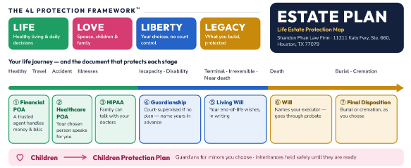
Free: The Life Estate Protection Map
Every document in a complete plan, and what happens without them, on one page.
Attend a Free Workshop
[DATE]
[Workshop topic, e.g. “Do I Really Need a Trust, or Is a Will Enough?”]
[Time] · [Location / Online] · [Language]
[Workshop topic, e.g. “Do I Really Need a Trust, or Is a Will Enough?”]
[Time] · [Location / Online] · [Language]