

Texas already shields more from creditors than almost any other state. Your homestead has no dollar limit. Retirement accounts, life insurance and wages are protected. Real asset protection in Texas is mostly about keeping what the law already gives you, adding structure where there is a genuine gap, and doing it long before anyone has a claim against you.
You are probably better protected than you think
People come to this page worried that a lawsuit could take everything. In Texas, usually it cannot. Start with what the law already gives you.
| What you own | What Texas law does |
|---|---|
| Your home | Protected with no dollar limit. Texas caps the homestead by size, not value — up to 10 acres in a city, or 200 acres in the country for a family and 100 for a single adult. A paid-off house in Houston is protected from ordinary creditors no matter what it is worth. (Property Code §41.002) |
| Retirement accounts | 401(k)s, IRAs and most pensions are exempt. |
| Life insurance and annuities | Exempt. |
| Your wages | Cannot be garnished in Texas for ordinary debts such as credit cards or medical bills. Child support, alimony, student loans and taxes are the exceptions. |
| Personal property | Up to $100,000 for a family, or $50,000 for a single adult — covering vehicles, furniture, tools of your trade, and more. (Property Code §42.001) |
A Texas family with a home, a retirement account and ordinary possessions is often close to judgment-proof already. That is worth knowing before you spend money on anything more complicated.
What these protections do not cover: a mortgage or home equity loan on the house itself, property taxes, mechanic's liens for work done on the home, federal tax liens, child support, and anything you personally guaranteed.
The most common mistake is giving up protection you already had
This is what we actually see. Not exotic creditors — ordinary people dismantling their own shelter without realising it.
- Cashing out a retirement account to pay credit cards. You just converted protected money into a payment on a debt that could not reach it. If bankruptcy follows anyway, the money is gone and the protection is gone with it.
- Borrowing against the house to pay unsecured debt. The credit card could never touch your home. The home equity lender can.
- Moving the homestead into an LLC or the wrong kind of trust. Homestead protection attaches to a home you own and occupy. Transfer it into an entity and you can lose it entirely — trading unlimited protection for a structure that gives you less.
- Running business money through a personal account. An LLC protects you only while it is treated as a separate thing. Commingle the money and a court can disregard the entity, which is the single most common way liability shields fail.
- Signing personal guarantees without noticing. Leases, equipment finance, lines of credit. A guarantee makes the debt yours personally, and the entity you formed becomes irrelevant for that debt.
Several of these are reversible if we catch them early. Some are not.
When is it too late?
This is the part most websites leave out, and it is the part you most need to know.
Asset protection is planning done in calm weather. Once a claim exists — once you have been sued, or you know a claim is coming — moving assets around is not protection. It is a fraudulent transfer, and Texas law lets a court undo it.
Under the Texas Uniform Fraudulent Transfer Act, a creditor can challenge a transfer made with intent to hinder, delay or defraud them for four years after it happened — and where the transfer was hidden, for a year after it was or reasonably could have been discovered. Courts look at the obvious signals: Did you transfer to a family member? Did you keep using the asset? Did it happen just after you were sued? Were you left unable to pay your debts?
Transfers made too late do not just fail. They can make everything worse — costs awarded against you, and a judge who now doubts everything else you say.
What actually works, and when
Protection is layered. Start at the top — it is cheapest and it stops the most.
| Layer | What it does | Who needs it |
|---|---|---|
| Insurance | Transfers the risk to somebody else for a few hundred dollars a year. An umbrella policy over your home and auto is the best value in this entire field. | Everyone, and almost everyone is underinsured. |
| Texas exemptions, used properly | Costs nothing. Mostly a matter of not undoing them, and of holding assets in protected forms rather than unprotected ones. | Everyone. |
| A separate entity for the business | Keeps business liabilities away from personal assets — as long as it is respected. An LLC interest in Texas also has charging order protection, which limits what a creditor of the owner can reach. | Anyone who owns a business or rental property. |
| Separate entities per property | One lawsuit against one rental does not reach the others. | Landlords with more than one property. |
| Trusts for the next generation | A lifetime trust means what your children inherit is not an asset in their divorce or a target for their creditors. | Anyone leaving money to children. |
| Long-term care planning | Certain irrevocable trusts, used five or more years early, change what Medicaid counts and what the state can later recover. | Anyone over about sixty. |
What about a "Texas asset protection trust"?
Be careful here, because this is where people get sold something that does not do what they were told.
Texas does not allow you to put your own assets into a trust, remain the beneficiary of that trust, and keep your own creditors away from it. Property Code §112.035 is explicit: spendthrift language does not protect the portion of a trust that the person who created it can still benefit from. A handful of states — Nevada, South Dakota, Delaware — do allow this. Texas is not one of them, and there are narrow exceptions involving transfers between spouses that do not help most people.
So if someone offers you a Texas trust that protects your assets from your creditors while you keep the benefit of them, ask them to show you the statute. Trusts do real work in Texas — protecting what your children inherit, protecting a beneficiary with a disability, planning for long-term care. Protecting your own assets from your own creditors while you still enjoy them is not among them.
If you own a business or practice
Your exposure is different and usually larger. Four things matter more than anything else.
- The entity has to be respected, not just formed. Separate bank accounts. Minutes and resolutions. Contracts signed in the company's name, not yours. The filing is the easy part and it is not the part that fails.
- Read every personal guarantee before you sign. They are routine in leases and equipment finance, they are sometimes negotiable, and each one punches a hole through the structure you paid for.
- Separate the valuable things from the risky things. The building in one entity, the operating business in another. A claim against the business should not reach the real estate.
- Have a buy-sell agreement if you have a partner. Without one, a partner's death, divorce or bankruptcy can put you in business with their spouse, their heirs or their creditors.
How we work
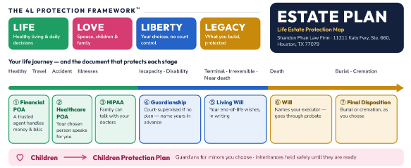
Asset protection sits inside the Liberty and Legacy pillars of the 4L Protection Framework. We start by mapping what you already have protected, because that is usually more than you expect, and then we look only at the real gaps. We do not sell structures nobody needs.
Where should you start?
Find out where you actually stand first. The audit takes about twelve minutes, it is free, and nothing is sold to you at the end.
Phục vụ cộng đồng người Việt tại Houston
Chúng tôi tư vấn bằng tiếng Việt. Nhiều gia đình Việt sở hữu cơ sở kinh doanh nhỏ, nhà cho thuê, hoặc đứng tên chung với người thân — đây là những trường hợp dễ mất tài sản nhất nếu không tách bạch đúng cách.
Consultations in Vietnamese. Many Vietnamese families own a small business, rental property, or hold title jointly with relatives — the situations where exposure is highest when things are not kept separate.
Get Answers to Your Questions
Free: The Life Estate Protection Map
Attend a Free Workshop
[Workshop topic, e.g. “Do I Really Need a Trust, or Is a Will Enough?”]
[Time] · [Location / Online] · [Language]