
Serving Houston, Katy, Sugar Land and Throughout Texas
An estate plan decides three things: who makes decisions for you if you cannot, who cares for the people who depend on you, and who receives what you own. Without one, Texas law decides all three — and for families with children from an earlier marriage, the Texas answer is rarely what anyone intended.
What happens if you die without a will in Texas?
Texas law writes one for you. It does not ask what you wanted.
Most people assume everything goes to their spouse. That is true only in one situation — when every one of your children is also your spouse's child. Change that one fact and the answer changes completely.
| What you own | All your children are also your spouse's children | You have a child from an earlier relationship |
|---|---|---|
| Community property — most of what a married couple builds together | Your half passes to your spouse. They own all of it. | Your half passes to your children. Your spouse keeps only their own half. |
| Separate personal property — what you owned before marriage, or inherited | One third to your spouse, two thirds to your children. | |
| Separate real property — land or a house owned before marriage, or inherited | Your spouse gets the use of one third for life. Your children own it. | |
Read the right-hand column again. A man with a son from a first marriage dies without a will. His widow does not inherit his half of the house they bought together. His son does — and his son is now her co-owner. She cannot sell or refinance without him. This happens in Texas constantly, and it happens to people who assumed a will was optional because "everything is in both our names."
A will takes an afternoon. This is what it prevents.
I already have a will. Isn't that enough?
It is a good start, and it is more than most people have. But a will has three blind spots worth knowing about.
- A will does nothing while you are alive. It takes effect only at death. If you are in a hospital bed and cannot speak, your will is just paper in a drawer. The documents that work in that moment are different ones.
- A will does not control everything you own. Retirement accounts, life insurance and anything with a named beneficiary pass directly to whoever is on the form. Your will cannot override them. We still regularly find a former spouse named on a 401(k).
- A will has to go through probate. In Texas that is usually straightforward — see the next section — but it is still a court process, and it is public.
Most wills we review are not wrong. They are just incomplete, and they are usually out of date. If yours is more than five years old, or if anything has changed in your family since you signed it, it is worth a look.
Do you actually need a trust?
Here is the honest answer, which is not the one most law firm websites give.
A lot of estate planning marketing treats probate as a disaster to be avoided at all costs. In California or New York, that is close to the truth. In Texas it is not.
Texas allows independent administration. If you leave a valid will naming an independent executor, your executor usually goes to court once, gets appointed, and then settles the estate without having to ask the judge for permission at every step. Texas also allows something called a muniment of title — a short procedure that can transfer property under a will with no administration at all, when there are no unpaid debts. Compared to most states, Texas probate is quick, private enough, and not especially expensive.
So a great many Texas families do not need a trust. A well-drafted will, the right powers of attorney, correct beneficiary designations and the right deed will do the job.
Some families genuinely do need one. Usually because of one of these:
| A trust is usually worth it when | Why |
|---|---|
| You own property in another state | Property in a second state means a second probate, in that state's courts. A trust avoids it. |
| You have a blended family | A will can leave everything to your spouse. It cannot stop your spouse from later leaving it to their own children instead of yours. A trust can. |
| A beneficiary has a disability | An inheritance paid directly can end their benefits. A properly drafted trust does not. |
| You want to protect what your children inherit | Money left outright becomes an asset in their divorce and a target for their creditors. Money left in trust does not. |
| Long-term care is on the horizon | Certain trusts, used early enough, change what Medicaid counts and what the state can later recover. |
| You want privacy, or you expect a fight | A will becomes a public court record. A trust does not, and it is harder to contest. |
If none of those describe you, be suspicious of anyone who tells you that you need a trust anyway. And if one of them does describe you, a will on its own is probably leaving a real risk on the table.
What is in a complete plan?
Five pieces. One of them almost never says what it needs to say.
- A will, a revocable living trust, or both. Which one depends on the section above.
- A durable power of attorney for money. This is the one. If you may ever need long-term care, Texas Estates Code §751.031 requires that Medicaid planning powers be spelled out. A general power of attorney does not give your family that authority. If the paper is silent and you can no longer sign, the only route left is asking a court to appoint a guardian, which takes months.
- A medical power of attorney, with a HIPAA release so the person you chose can actually be told what is happening.
- A directive to physicians and a declaration of guardian. Your wishes about treatment, and who a court should appoint if it ever comes to that.
- A plan for your children, if you have young ones. An emergency guardian who can act within the hour, a long-term guardian named in writing, and medical consent authority so the adult standing in the emergency room can sign.
Three families, three different plans
The documents are not the plan. What you need depends on who is sitting at your table.
Young parents
You own less than you will one day, and the stakes are higher than they will ever be again. The money matters far less than the question of who raises your children if you are both gone, and who can sign for them at a hospital tonight. This plan is mostly about people, and it is usually simple.
A business owner
Your plan has to answer what happens to the business on the Monday after. Who runs it, who owns it, whether your partner's family and your family end up negotiating during grief, and whether your personal assets are separated from what the business can expose you to. A standard will does none of that.
A second marriage
The hardest one, and the one most often done badly. You want to provide for your spouse and you want your children to receive what you intended. Leaving everything to your spouse outright does the first and quietly abandons the second — because nothing stops them from redirecting it later. This is the situation trusts were invented for.
What about the house?
For most Texas families the home is the largest thing they own, and how it is titled matters as much as what the will says.
There are several ways to pass a home: through a will, through a trust, by a Lady Bird deed, or by a transfer on death deed. They are not interchangeable, and one difference catches people out.
A transfer on death deed does not protect the home from claims against your estate. Texas Estates Code §114.106 says that if the estate does not have enough to pay what it owes, property passing by transfer on death deed can be reached anyway. A Lady Bird deed does not have that problem. The two are described online as if they were the same thing. They are not, and the difference matters most in exactly the situation where families need it to hold.
How we work
Every matter here runs through the 4L Protection Framework — Life, Love, Liberty and Legacy. It is how we find what is missing before we decide what to draft. We start with your gaps, not with a document list. Documents are the last conversation, not the first.
Where should you start?
If you are not sure what your family already has, find out first. The audit takes about twelve minutes, it is free, and nothing is sold to you at the end. You get a score, your gaps in order of urgency, and a page you can print and bring to any attorney you choose.
Take the 4L Family Protection AuditReserve a seat at the next free workshop — "Will or Trust? Get Clear Answers in One Evening"Book a confidential consultationCall or text (281) 407-5622
Phục vụ cộng đồng người Việt tại Houston
Chúng tôi tư vấn, tổ chức hội thảo và cung cấp tài liệu bằng tiếng Việt. Nhiều gia đình Việt còn có tài sản hoặc người thừa kế ở Việt Nam, hoặc có vợ/chồng chưa có quốc tịch Mỹ — những trường hợp này cần một kế hoạch riêng, và rất ít văn phòng luật tính đến.
Consultations, workshops and written materials are available in Vietnamese. Families with property or heirs in Vietnam, or a spouse who is not a U.S. citizen, need a plan built for that — and very few firms account for it.
Get Answers to Your Questions
Not sure where to start? Send us your question and we’ll point you in the right direction.
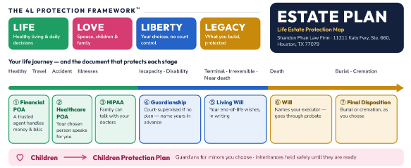
Free: The Life Estate Protection Map
Every document in a complete plan, and what happens without them, on one page.
Attend a Free Workshop
[DATE]
[Workshop topic, e.g. “Do I Really Need a Trust, or Is a Will Enough?”]
[Time] · [Location / Online] · [Language]
[Workshop topic, e.g. “Do I Really Need a Trust, or Is a Will Enough?”]
[Time] · [Location / Online] · [Language]